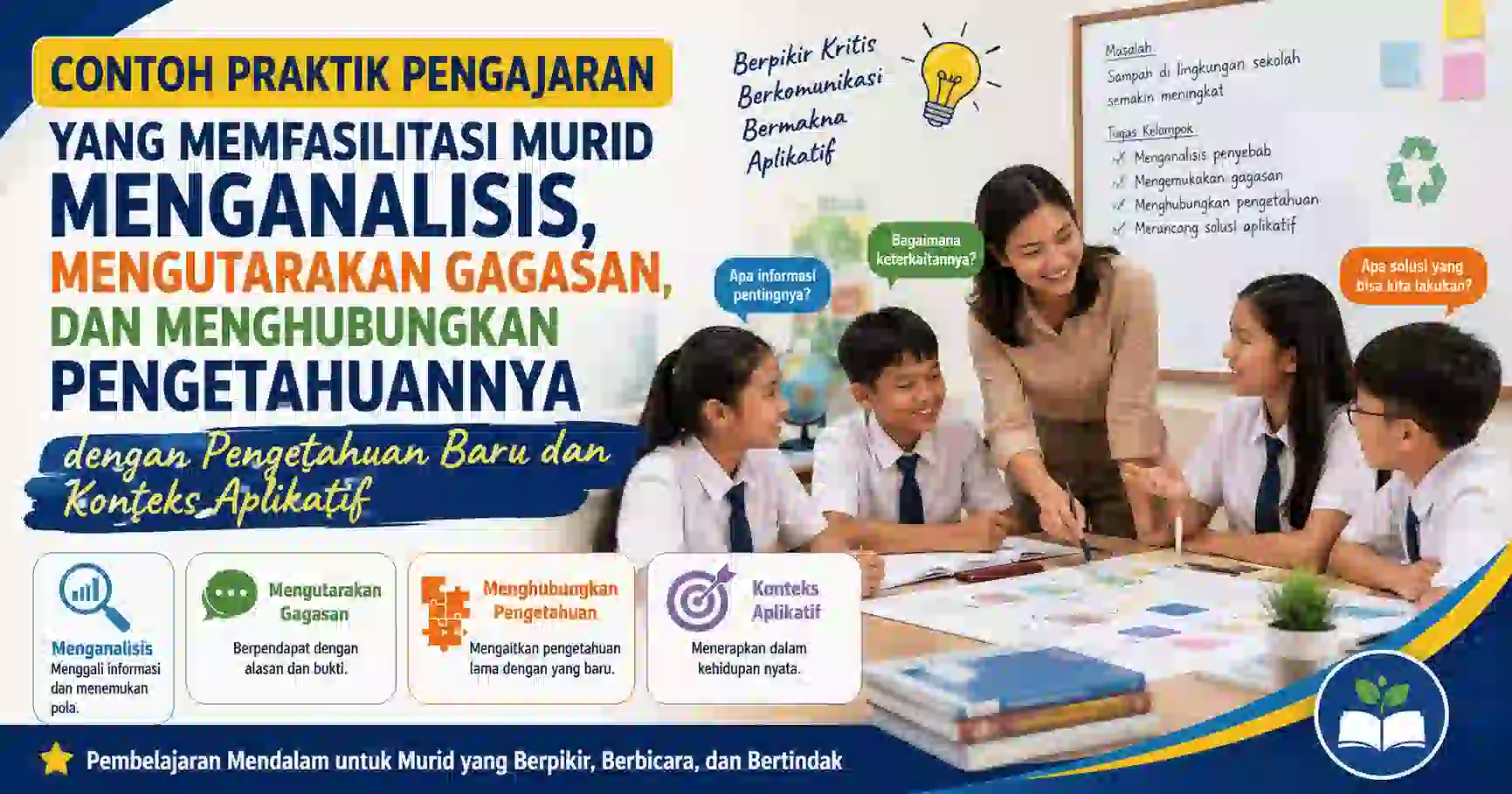
forumguru.id The quality of learning is strongly influenced by how well teachers design the learning process before entering the classroom. A good lesson plan does not merely determine what students will learn, but also considers how students will experience learning, how they will develop understanding, how they will apply knowledge, and how they will reflect on what they have learned.
This is the foundation of Deep Learning in education.
In the Indonesian education context, Deep Learning or Pembelajaran Mendalam is an instructional approach that emphasizes learning that is mindful, meaningful, and joyful. It is designed to move learning beyond memorization toward deeper understanding, contextual application, reflection, and holistic student development. The Ministry of Primary and Secondary Education describes Deep Learning as an approach that places students at the center of learning and integrates intellectual, ethical, aesthetic, and kinesthetic development.
Therefore, implementing Deep Learning in the classroom requires more than changing teaching methods. Teachers need a systematic learning design model that connects learning objectives, learning experiences, pedagogical practices, assessment, and reflection.
This article discusses practical learning design models for implementing Deep Learning in the classroom, including their principles, stages, examples, and assessment strategies.
What Is Deep Learning in Classroom Learning?
Deep Learning is an educational approach that aims to develop students’ ability to understand concepts deeply, connect knowledge with real-life situations, apply what they have learned, think critically, collaborate, and reflect on their learning.
It should not be confused with deep learning in artificial intelligence.
In education, Deep Learning focuses on the quality and depth of the learning experience.
The approach is built around three major principles:
- Mindful Learning – learning with awareness and active attention.
- Meaningful Learning – connecting knowledge with real-life contexts and students’ experiences.
- Joyful Learning – creating positive, engaging, challenging, and enjoyable learning experiences.
The three principles are intended to work together rather than operate independently. Recent research describes meaningful learning as supporting conceptual understanding, joyful learning as encouraging engagement, and mindful learning as strengthening reflection and metacognitive development.
Why Does Deep Learning Require a Learning Design Model?
A common mistake is to consider Deep Learning simply as a collection of teaching techniques.
Using group work, games, projects, or technology does not automatically make learning “deep.”
Deep Learning requires alignment between:
- learning objectives;
- learning content;
- student needs;
- learning activities;
- learning environment;
- assessment;
- reflection; and
- expected graduate competencies.
The official framework for Deep Learning in Indonesia consists of four interconnected components:
- Graduate Profile Dimensions
- Learning Principles
- Learning Experiences
- Learning Framework
The learning framework also emphasizes pedagogical practices, learning partnerships, digital utilization, and the learning environment.
This means that teachers need a learning design that begins with the desired learning outcomes and then deliberately constructs experiences that lead students toward those outcomes.
The Main Model of Deep Learning Lesson Design
A practical classroom model can be organized into six interconnected stages:
Identify → Design → Engage → Understand → Apply → Reflect
These stages are not intended to replace the official curriculum framework. Instead, they provide a practical way for teachers to translate Deep Learning principles into classroom planning.
1. Identify: Identify Learning Goals and Student Needs
The first step is identifying what students are expected to understand and develop.
Teachers should not begin planning simply by asking:
“What material should I teach?”
Instead, ask:
“What should students understand, be able to do, and become after this learning experience?”
Learning objectives should ideally address more than factual knowledge.
For example, instead of:
Students can define environmental pollution.
A deeper objective would be:
Students can analyze causes of environmental pollution, evaluate its impact on their community, and propose practical solutions.
The second objective requires students to understand, analyze, apply, and create.
Teachers should also consider:
- students’ prior knowledge;
- learning readiness;
- interests;
- learning difficulties;
- local context;
- available resources; and
- students’ social and cultural environment.
2. Design: Design Meaningful Learning Experiences
Once learning goals have been identified, teachers design learning experiences that connect the subject with students’ lives.
Meaningful learning asks:
Why does this knowledge matter to students?
For example, when teaching mathematics about percentages, teachers can connect the concept to:
- discounts;
- household budgets;
- savings;
- school fundraising;
- business;
- population statistics; or
- data from the local community.
When students understand the relevance of a concept, learning becomes more meaningful.
Research on Deep Learning implementation in schools emphasizes contextual learning and connections between learning materials and students’ real experiences.
3. Engage: Create a Mindful and Joyful Learning Environment
The next stage is creating an environment in which students are ready to learn.
Mindful learning means that students are consciously engaged in the learning process.
Teachers can begin a lesson by:
- presenting a real-world problem;
- showing a picture or short video;
- asking an intriguing question;
- conducting a simple experiment;
- presenting contradictory information;
- inviting students to share prior experiences; or
- using a short reflection activity.
For example:
“Why does the temperature in some parts of our city feel hotter than in others?”
Such a question can encourage students to observe, question, investigate, and connect prior knowledge with new information.
At the same time, the classroom should be joyful.
Joyful learning does not mean that every lesson must be entertaining. Rather, students should experience learning as positive, engaging, challenging, and emotionally supportive. The Ministry’s guidance describes joyful learning as an environment that motivates students and helps them connect emotionally with learning.
4. Understand: Guide Students Toward Deep Understanding
After students become engaged, teachers guide them toward deeper conceptual understanding.
This stage may involve:
- inquiry;
- observation;
- reading;
- discussion;
- experimentation;
- comparison;
- analysis;
- questioning;
- investigation; and
- collaborative problem-solving.
Teachers should avoid immediately providing every answer.
Instead, students should have opportunities to construct understanding through guided exploration.
Example
Suppose the topic is water pollution.
Instead of simply explaining the causes of water pollution, teachers can ask students to:
- observe pictures of polluted rivers;
- identify visible problems;
- discuss possible causes;
- investigate supporting information;
- compare different cases;
- determine consequences; and
- explain relationships between human activities and pollution.
Students are therefore not merely memorizing “causes of pollution.” They are developing an understanding of cause, effect, evidence, and relationships.
5. Apply: Use Knowledge in New Contexts
Deep learning becomes stronger when students can use what they understand.
The application stage can involve:
- projects;
- experiments;
- simulations;
- problem-solving;
- presentations;
- debates;
- product creation;
- community activities; or
- interdisciplinary tasks.
The important question is:
“Can students use what they have learned beyond the original example?”
For example, after learning about environmental pollution, students might be asked to design a school waste-reduction campaign.
This requires them to apply scientific knowledge, communication skills, creativity, collaboration, and problem-solving.
The Ministry’s learning framework emphasizes experiences in which students understand, apply, and reflect on knowledge.
6. Reflect: Make Learning Conscious and Sustainable
Reflection is an essential component of Deep Learning.
Without reflection, students may complete activities without fully understanding what they have learned from them.
Teachers can ask:
- What did I learn?
- What was the most important idea?
- What was difficult?
- What evidence changed my thinking?
- How can I apply this knowledge?
- What would I do differently next time?
- What do I still need to understand?
Reflection can be conducted through:
- learning journals;
- exit tickets;
- self-assessment;
- peer feedback;
- portfolios;
- group discussions; or
- short written reflections.
Research on Deep Learning has highlighted that the mindful dimension can be more difficult to implement systematically than meaningful and joyful learning, making structured reflection particularly important.
A Practical Deep Learning Lesson Design Model
Teachers can summarize the planning process in the following model:
| Identify | Determine learning goals and student needs | Understand the purpose of learning |
| Design | Connect content with real-life contexts | See the relevance of learning |
| Engage | Build mindful and joyful classroom conditions | Become attentive and motivated |
| Understand | Facilitate inquiry and conceptual development | Explore and construct understanding |
| Apply | Provide authentic problems or tasks | Use knowledge in new situations |
| Reflect | Facilitate reflection and feedback | Evaluate learning and improve |
This model can be adapted to different subjects and grade levels.
Example of Deep Learning Lesson Planning
Topic: Environmental Pollution
Learning Objective
Students are expected to:
- explain the causes of environmental pollution;
- analyze its impact on the local environment;
- collaborate to investigate an environmental problem; and
- propose practical solutions.
Learning Experience
Opening
The teacher presents photographs of a polluted river near a community.
Students observe the images and answer:
“What problems do you see?”
“What might have caused them?”
“How could this problem affect people’s lives?”
Understanding
Students work in groups to investigate:
- sources of pollution;
- environmental consequences;
- effects on human health and ecosystems;
- community behavior; and
- possible solutions.
Application
Each group develops a practical proposal such as:
- a school waste-management campaign;
- a plastic reduction program;
- a river-cleaning campaign;
- an environmental poster campaign; or
- a community awareness project.
Reflection
Students write a short reflection:
“What did I understand about environmental pollution that I did not understand before?”
“What action can I personally take?”
This single learning sequence integrates mindful, meaningful, and joyful learning while also encouraging critical thinking, collaboration, creativity, communication, and problem-solving.
Learning Models That Can Support Deep Learning
Deep Learning is not limited to one teaching model. Teachers can use different pedagogical models depending on the learning objectives.
1. Project-Based Learning
Project-Based Learning is particularly useful when students need to investigate authentic problems and create products or solutions.
Projects can encourage:
- collaboration;
- creativity;
- communication;
- critical thinking;
- independence; and
- real-world application.
Recent research identifies project-based learning as one strategy that can support Deep Learning implementation.
2. Problem-Based Learning
Problem-Based Learning begins with a problem that requires students to investigate and develop solutions.
This model is suitable for subjects that require:
- analysis;
- reasoning;
- decision-making;
- investigation; and
- problem-solving.
3. Inquiry-Based Learning
Inquiry encourages students to ask questions, investigate evidence, construct explanations, and communicate conclusions.
It is highly compatible with the mindful dimension of Deep Learning because students actively engage with the learning process.
4. Collaborative Learning
Collaboration enables students to learn from one another.
Students can:
- discuss ideas;
- compare perspectives;
- divide responsibilities;
- provide feedback; and
- construct solutions together.
5. Contextual Learning
Contextual learning connects classroom content with students’ everyday experiences.
This is particularly important for meaningful learning because students can see why knowledge matters.
Designing Assessment for Deep Learning
Assessment should be aligned with the learning objectives.
If the objective is simply to remember information, a conventional test may be appropriate.
However, if students are expected to analyze, apply, create, collaborate, and reflect, assessment should capture those abilities.
Teachers can use:
Formative Assessment
Examples include:
- questioning;
- classroom observation;
- discussion;
- concept maps;
- quick quizzes;
- student explanations; and
- exit tickets.
Performance Assessment
Students demonstrate their ability through:
- projects;
- presentations;
- experiments;
- demonstrations;
- products; or
- authentic tasks.
Portfolio Assessment
A portfolio can document students’ progress over time and include:
- assignments;
- project results;
- reflections;
- feedback;
- revisions; and
- evidence of learning.
Self and Peer Assessment
Students can evaluate their own learning and provide constructive feedback to classmates.
This strengthens reflection and learning responsibility.
Official guidance emphasizes that learning and assessment principles should be considered together when planning Deep Learning, with assessment conducted fairly, objectively, and educationally.
The Role of the Teacher in Deep Learning Design
The teacher remains central to Deep Learning, but the role changes from being primarily a transmitter of information to becoming a learning designer and facilitator.
A Deep Learning teacher:
- identifies meaningful learning goals;
- understands students’ needs;
- designs authentic learning experiences;
- asks thought-provoking questions;
- provides appropriate scaffolding;
- facilitates collaboration;
- gives constructive feedback;
- encourages reflection; and
- evaluates learning continuously.
A 2026 teacher-development study specifically focused on strengthening teachers’ capacity to design Deep Learning through lesson plans, student worksheets, project-based activities, and digital learning media connected to local cultural contexts.
The Role of Technology in Deep Learning
Technology can support Deep Learning, but technology itself does not guarantee deep learning.
Digital tools can be used to:
- investigate information;
- collect data;
- collaborate;
- create multimedia products;
- simulate phenomena;
- communicate ideas; and
- document learning.
However, the key question should always be:
“Does this technology make students think, understand, apply, create, or reflect more deeply?”
If technology is used only to replace paper worksheets with digital worksheets, the learning experience may not become deeper.
The official Deep Learning framework recognizes digital utilization as one component of the broader learning framework.
Common Mistakes in Implementing Deep Learning
Teachers should avoid several common misconceptions.
1. Giving More Assignments
More assignments do not automatically mean deeper learning.
2. Making Lessons More Difficult
Deep Learning is not about making content unnecessarily difficult. It is about increasing the depth of understanding.
3. Using Games in Every Lesson
Joyful learning is not synonymous with entertainment. The activity must still serve meaningful learning goals.
4. Ignoring Reflection
A project without reflection may produce a product but not necessarily deep learning.
5. Focusing Only on Academic Knowledge
Deep Learning aims at holistic development, including cognitive, affective, social, and metacognitive dimensions.
6. Using Technology Without a Pedagogical Purpose
Digital tools should support learning objectives rather than become the objective themselves.
How Schools Can Support Deep Learning
Successful implementation cannot depend solely on perseorangan teachers.
Schools should develop an environment that supports Deep Learning through:
- continuous teacher professional development;
- collaborative lesson planning;
- sharing of successful classroom practices;
- appropriate learning resources;
- supportive school leadership;
- authentic assessment practices;
- meaningful partnerships with parents and communities; and
- effective use of digital technology.
The official Deep Learning framework places emphasis not only on pedagogical practice but also on learning partnerships, learning environments, and digital utilization.
Conclusion
Deep Learning requires deliberate learning design. It is not simply a teaching method, a classroom activity, or the use of technology.
An effective Deep Learning lesson begins with clear learning goals and student needs, continues through meaningful and engaging experiences, provides opportunities for students to develop understanding and apply knowledge, and concludes with reflection and assessment.
A practical model for teachers is:
Identify → Design → Engage → Understand → Apply → Reflect
When these stages are connected with the principles of Mindful, Meaningful, and Joyful Learning, classroom learning can move beyond memorization toward deeper understanding and real-world application.
Ultimately, the success of Deep Learning depends not on how much material a teacher can deliver, but on how deeply students understand, how meaningfully they apply what they learn, and how consciously they reflect on their learning.
The goal is therefore not simply to produce students who know more, but students who can think deeply, act meaningfully, collaborate effectively, solve problems, and continue learning throughout life.
Frequently Asked Questions (FAQ)
1. What is a Deep Learning lesson design model?
A Deep Learning lesson design model is a systematic framework for planning classroom learning so that students develop deep understanding through mindful, meaningful, and joyful learning experiences.
2. What are the main stages of Deep Learning lesson planning?
A practical model consists of six stages: Identify, Design, Engage, Understand, Apply, and Reflect.
3. Is Deep Learning the same as Project-Based Learning?
No. Project-Based Learning is one pedagogical model that can support Deep Learning. Deep Learning is broader and concerns the overall quality and depth of students’ learning experiences.
4. What are the three principles of Deep Learning?
The three principles are Mindful Learning, Meaningful Learning, and Joyful Learning.
5. How can teachers make learning meaningful?
Teachers can connect lessons with students’ prior knowledge, everyday experiences, local environments, real-world problems, and authentic tasks.
6. Why is reflection important in Deep Learning?
Reflection helps students become aware of what they have learned, identify difficulties, evaluate their thinking, and determine how they can improve.
7. What learning models can be used for Deep Learning?
Teachers can use Project-Based Learning, Problem-Based Learning, Inquiry-Based Learning, Collaborative Learning, Contextual Learning, and other models that support the intended learning outcomes.
8. Does Deep Learning require digital technology?
No. Technology can support Deep Learning, but it is not mandatory. The quality of the learning experience and the alignment between objectives, activities, and assessment are more important.
9. How should Deep Learning be assessed?
Assessment should measure not only knowledge but also understanding, application, reasoning, problem-solving, creativity, collaboration, performance, and reflection.
10. What is the most important element of Deep Learning lesson planning?
The most important element is alignment: learning objectives, learning experiences, pedagogical practices, assessment, and reflection should work together to produce meaningful and deep learning.
References
- Ministry of Primary and Secondary Education of the Republic of Indonesia. Academic Paper on Deep Learning. Official curriculum resources.
- Ministry of Primary and Secondary Education of the Republic of Indonesia. Revised 2025 Guide for Developing the Education Unit Curriculum.
- Ministry of Primary and Secondary Education of the Republic of Indonesia. Subject Guide: Social Sciences – Deep Learning Planning.
- Kurnianingsih, E., Prayitno, H. J., Mu’ti, A., Baidhawy, Z., & Jufriansah, A. (2026). Deep Learning as an Integrated Pedagogical Framework: Synthesizing Mindful, Meaningful, and Joyful Learning for Transformative Educational Experiences. Journal of Deep Learning, 2(2), 125–143.
- Andayanie, L. M., Adhantoro, M. S., Purnomo, E., & Kurniaji, G. T. (2025). Implementation of Deep Learning in Education: Towards Mindful, Meaningful, and Joyful Learning Experiences. Journal of Deep Learning, 1(1), 47–56.
- Hanipah, S., Day, W. O. S. H., Hanip, R., & Fredy. (2026). Penguatan Kompetensi Guru dalam Merancang Pembelajaran Deep Learning yang Mindful, Meaningful, and Joyful. Jurnal Pengabdian UNDIKMA, 7(1), 313–323.
- Munawarah, Mutmainah, Mizani, H., & Djamarah, S. B. (2026). Desain Pembelajaran Berbasis Deep Learning dalam Mewujudkan Pembelajaran Mindful, Meaningful, dan Joyful. JIS: Journal Islamic Studies, 4(2), 460–470.
- Fauziah, U. N., Arman, Ramadani, S., Mahfuroh, L., Adetia, M. F., & Sutari, D. (2025). Implementasi Prinsip-Prinsip Deep Learning dalam Pembelajaran di Sekolah Dasar. Edukasi Tematik: Jurnal Pendidikan Sekolah Dasar.