Fomc
Portal Media Online Indonesia
Mesin Pencari Kincai Media

Federal Open Market Committee
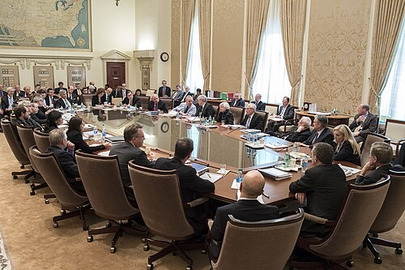
The Federal Open Market Committee is a committee within the Federal Reserve System that is charged under United States law with overseeing the nation's open market operations. This Federal Reserve committee makes key decisions about interest rates and the growth of the United States money supply. Under the terms of the original Federal Reserve Act, each of the Federal Reserve banks was authorized to buy and sell in the open market bonds and short term obligations of the United States government, bank acceptances, cable transfers, and bills of exchange. Hence, the reserve banks were at times bidding against each other in the open market. In 1922, an informal committee was established to execute purchases and sales. The Banking Act of 1933 formed an official FOMC. The FOMC is the principal organ of United States national monetary policy.
Sumber Data : Wikipedia
- Entity: Government Agency
- Formed: June 16, 1933
- Jurisdiction: United States
- Headquarters: Eccles Building, Washington, D.c.
- Employees: 12 Voting Members
- executives: Kevin Warsh, Chairman, John C. Williams, Vice Chairman
- Parent agency: Federal Reserve System
- Wikidata description: Committee Of The United States Federal Reserve
- Wikidata label: Federal Open Market Committee
- Wikidata aliases: Federal Open Market Committee, Fomc
- Related Topics: Banking Act Of 1933 And 1935 – Created And Gave Voting Rights To The 7 Federal Reserve Board Of Governors Appointed By The President, There Are A Total Of 12 Fomc Members., Federal Funds Rate - The Federal Funds Rate Is The Interest Rate At Which Depository Institutions Lend Reserve Balances To Other Depository Institutions Overnight On An Uncollateralized Basis. Reserve Balances Are Amounts Held At The Federal Reserve., Monetary Policy Committee, Money Creation — Private Banks Are The Primary Creators And Retirement Of Money When Issuing And Collecting The Principal On Loans., Taylor Rule - The Taylor Rule Is A Monetary Policy Targeting Rule. The Rule Was Proposed In 1992 By American Economist John B. Taylor For Central Banks To Use To Stabilize Economic Activity By Appropriately Setting Short-Term Interest Rates., Forward Guidance - Forward Guidance Is A Tool Used By A Central Bank To Exercise Its Power In Monetary Policy In Order To Influence, With Their Own Forecasts, Market Expectations Of Future Levels Of Interest Rates. Communication About The Likely Future Course Of Monetary Policy Is Known As "Forward Guidance"., Committees, Federal Reserve System


Artikel Populer

Kebiasaan di Media Sosial yang Sebaiknya Dihindari Demi Kesehatan Mental

15 Film Indonesia Terbaru September 2026, Tontonan Terbaik Akhir Pekan!